Bat box checks : first impressions
As a follow-on from Claire’s recent blog post about the bat group’s monitoring at Clayfield copse, near Reading, two volunteers new to bat box checks offered to contribute their experience of the next box check at the site, without having to have their arms twisted too much. David and Seb came to the event with different backgrounds – David as a fairly recent member of the bat group, having volunteered on citizen science detector-based surveys & run bat walks for his scout troop, while Seb has been a professional ecologist for some years without ever having got up close to any bats.
Introductions
David:
I’ve been a member of BSBBG for a couple of years, and I’m enjoying it immensely. Various other commitments mean I’m not especially active in the group but in addition to three online BCT courses, I’ve attended a number of excellent seminars run in person by BSBBG members, and several bat walks. I’ve completed two NBMP waterway surveys and one field survey, with help for my first waterway survey from the brilliant Claire T and Andrew. I’ve run three well-received bat walks for various sections of the Scout troop for which I volunteer. So I’m not a complete and utter first-timer, but so many folks with more than ten times my experience seem to call themselves beginners, so it’s all relative. I’m simply impressed with how knowledgeable and patient other members of this group are, and how readily they volunteer to put that knowledge to use in surveying, counting, caring for and telling the public about their local bats.
Finally having a free weekend that coincided with a box check, I joined Claire Andrews and her team of volunteers at the bat box checks on Sunday 27th September. Her joining instructions were great – to the point covering everything we needed to know and the logistics worked out nicely. Other participants had a fair range of experience: several were professional ecologists, some were not but had been doing this for years and a few of us were more or less first timers.
Seb:
As an ecologist by trade, you might say that bats is sort of the bread and butter of my industry. Over the years I’ve been surrounded by bats in both a hands-off and practical sense. I’ve had experience with bats with anything from emergence surveying to mitigation to practical inspections of features on trees through climbing, and (mostly) anything in between. It might then come as a surprise that over these years I have never actually held a bat or found them in situ over these many checks as part of my career! How can I truly claim to understand them fully without spending time with them up-close and personally.
I’ve been aware of the Berkshire and South Buckinghamshire Bats Group (BSBBG for those in a rush) for some time now, and after having joined earlier this year was given the opportunity to assist on a bat box check at their site at Clayfield Copse and Blackhouse Woods in Caversham. Following a quick nosey, I discovered that several European Protected Species Licence (EPSL) applications had been made in close proximity to the site, covering species such as common and soprano pipistrelle, brown long-eared, serotine, Daubenton’s and Natterer’s bats. I also discovered that I likely need to get out more.
Impressions of the site
David:
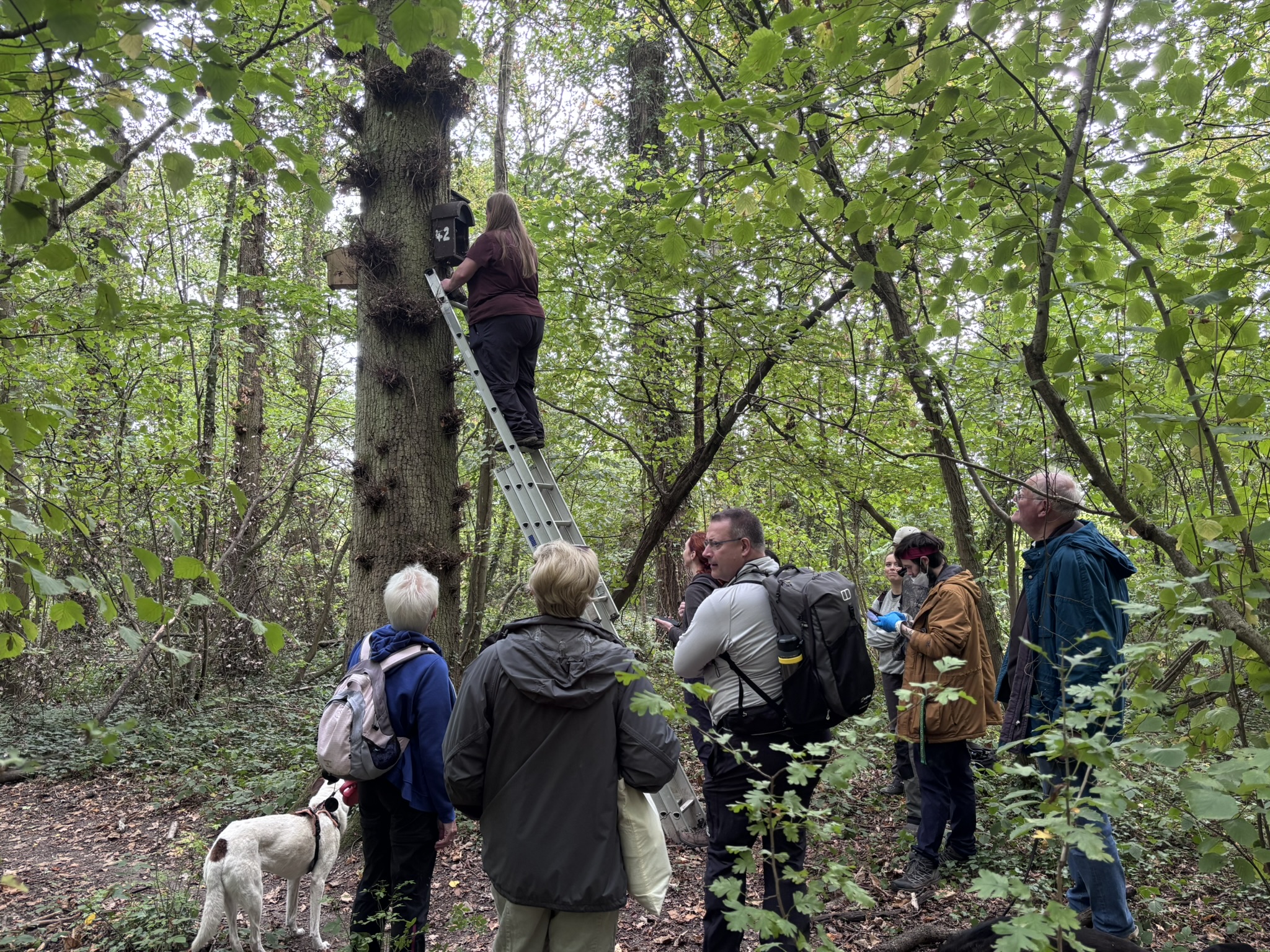
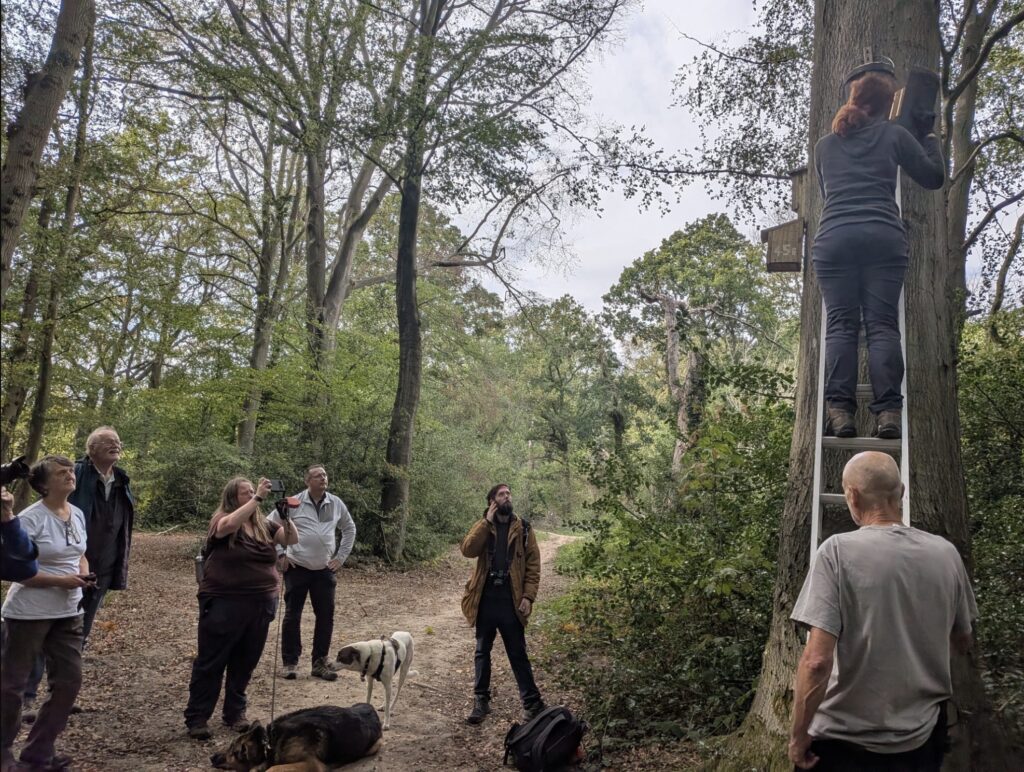
Over the course of a cool day in the woods, we (others more than I) climbed ladders to inspect at least 30 boxes of various designs. Most trees bore multiple different boxes, either with the idea of learning which were preferred by which species, to accommodate species with differing preferences, or to provide nest boxes more ideally suited to birds in the hope of dissuading them from nesting in the bat boxes. Our checks through the day turned up many birds’ nests, unoccupied given the season. The box I checked myself had a nest with two desiccated chicks in it. The majority revealed no bats – not unusual.
Seb:
The site consists of what I can only assume is an ever-expanding number of bat boxes thanks to the craftsmanship of one ‘Handy’ Andy Cruse, including one large box used for the reintroduction of a hand-reared noctule created to mimic a large woodpecker hole on a tree.
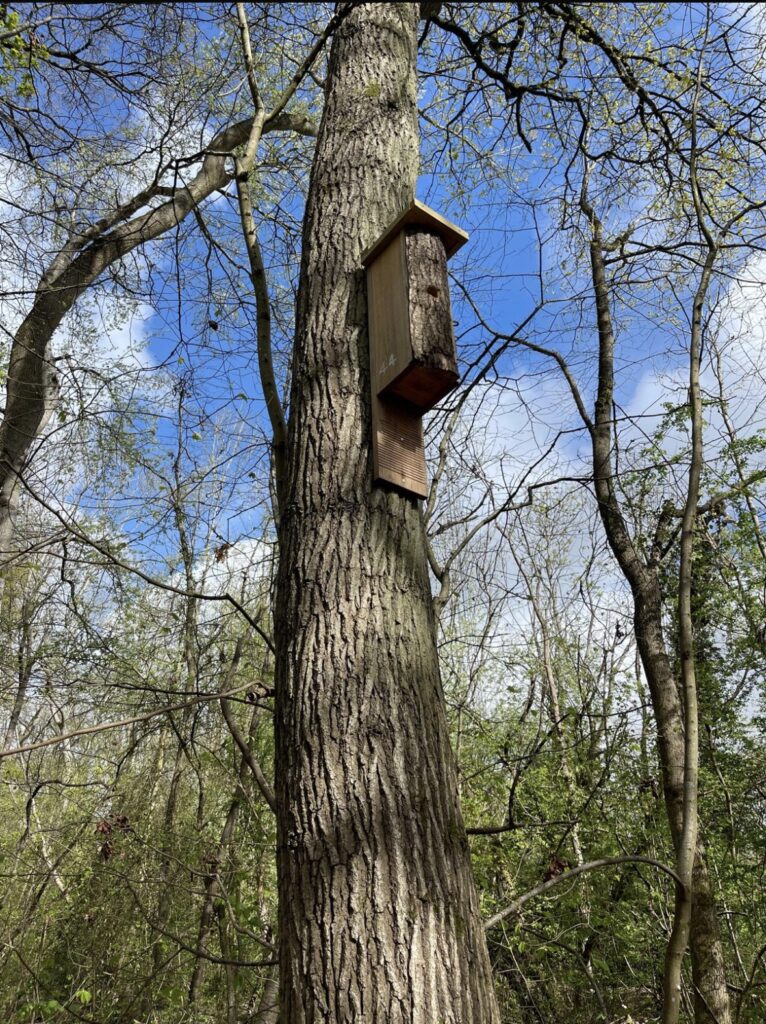
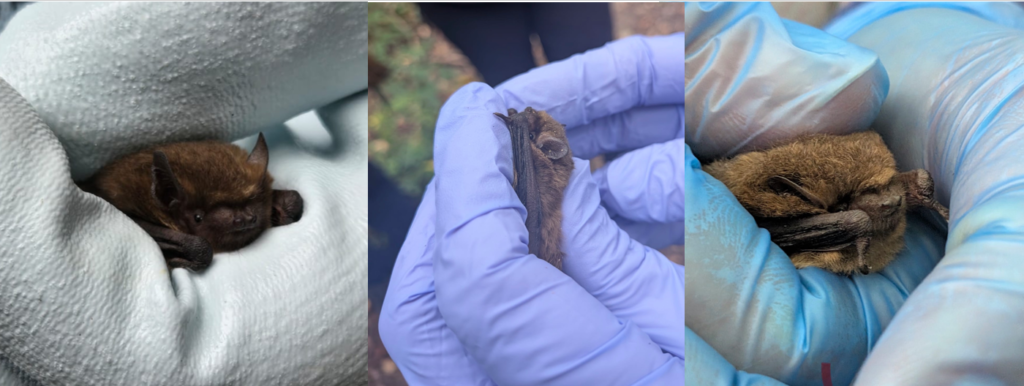
Interestingly, the success rate for roosting bats during checks over the past decade or so has been tracked, showing us the difference between fancy Schwegler boxes and far cheaper alternatives. While the stats indicated that it would be a washout in favour of the high-tech prowess of German engineering, it was actually a humble cheap box (cost-effective is how I’ll phrase it from now on!) that gave us our first gaggle (or colony if I was wearing my ecologist hat) of bats. One male and four females. This is where I got my first in-person taste of visual ID of a bat species as well as sexing, with the clues pointing to a group of soprano pipistrelles.
The bats
David:
We’d hoped for some noctules or Daubenton’s but in the end only (!) found pips. This was no disappointment to me; any bat is a good bat, and I relished the chance to be shown how to handle and examine one myself.
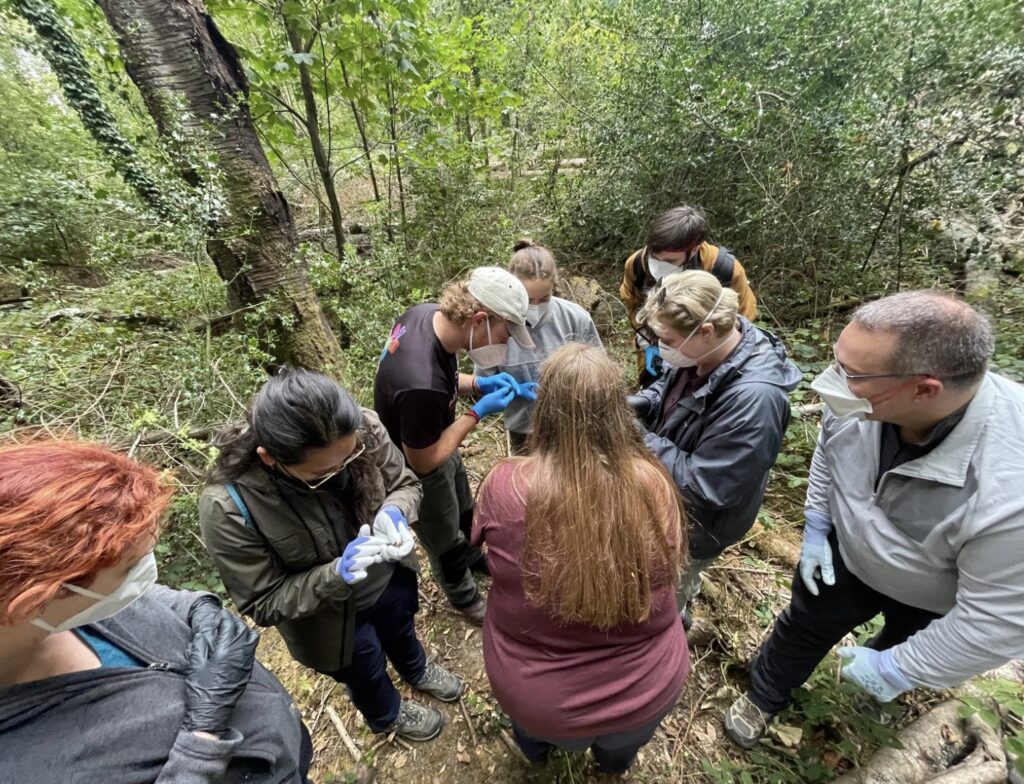
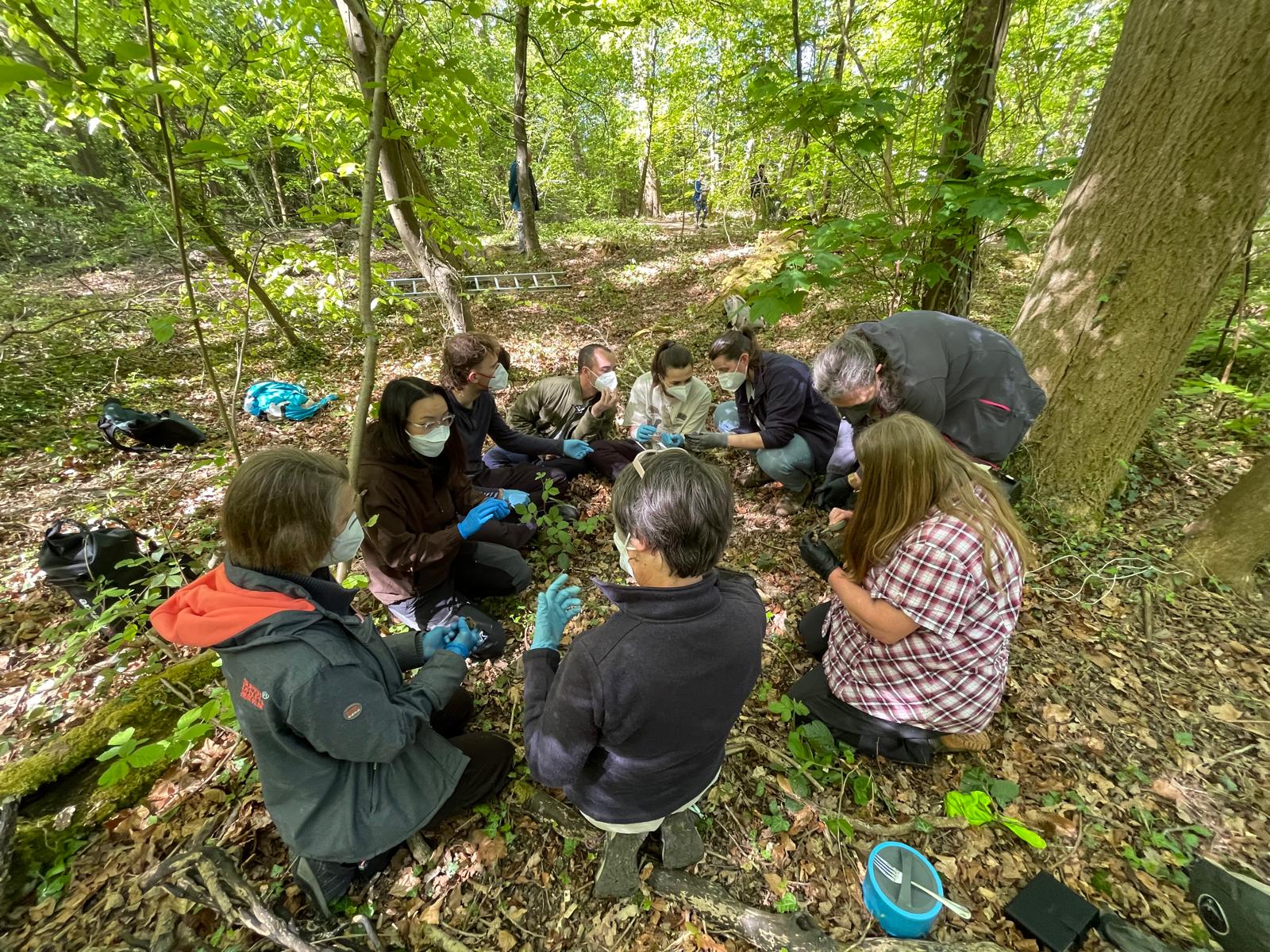
The pipistrelles in the first bat box we opened showed no great irritation at being woken on a crisp Sunday morning, but they obviously hadn’t expected it. Observed by a dozen or so other volunteers, Claire, Alice, Andy and Rose-Ann patiently showed us less experienced members how to access and inspect the boxes, carefully retrieve any sleeping residents within, and how to hold them without injuring either the bats or ourselves. They explained how to identify the bats’ species using a sequence of distinctive physical features, and how to tell their sex. Seeing the little creatures so calmly accept the indignity of having their noses, ears, wings and willies peered at shows how skilful these experienced handlers were. It didn’t take long.
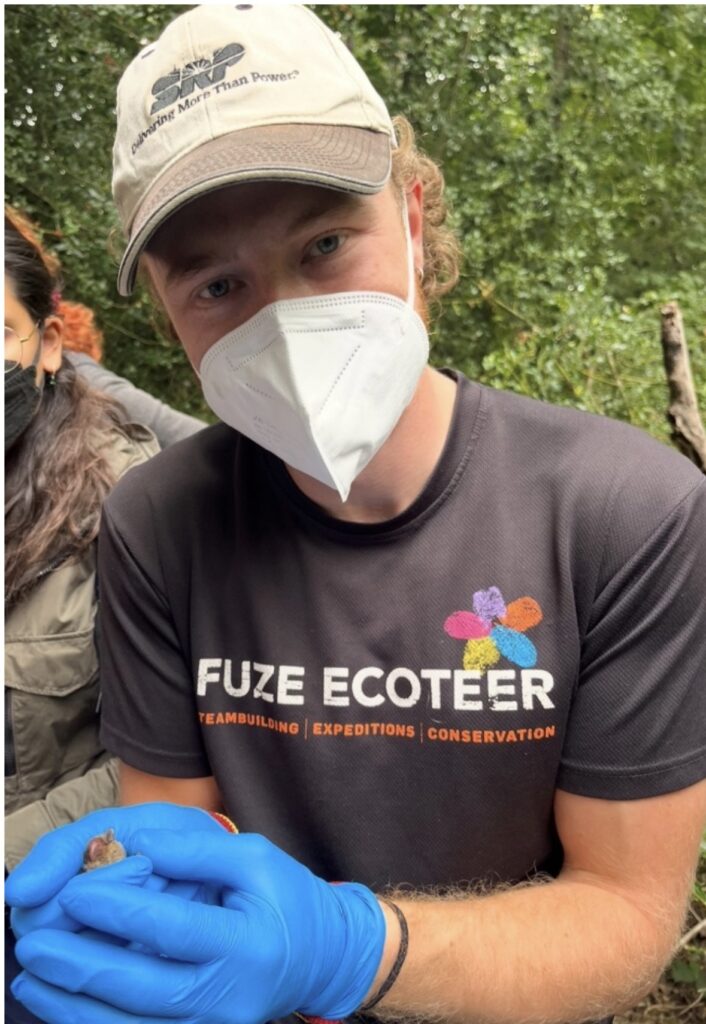
Under careful supervision, the bat I handled was examined and identified as carefully as the others: a successful male, given that he was found with a harem of four females. A nearby box turned up our last bat of the day, a solitary male who had apparently been outdone by his more attractive neighbour.Their particulars logged, the pips were gently placed back in their chosen roost, with a rag temporarily stuffed in the box entrance to discourage immediate flight in both senses. We left them to recover their composure, and the rag was later pulled out by a string.
We also passed several promising-looking cracks in trees, which were explored with an endoscope. They were unoccupied, but it was well worth a look.
Seb:
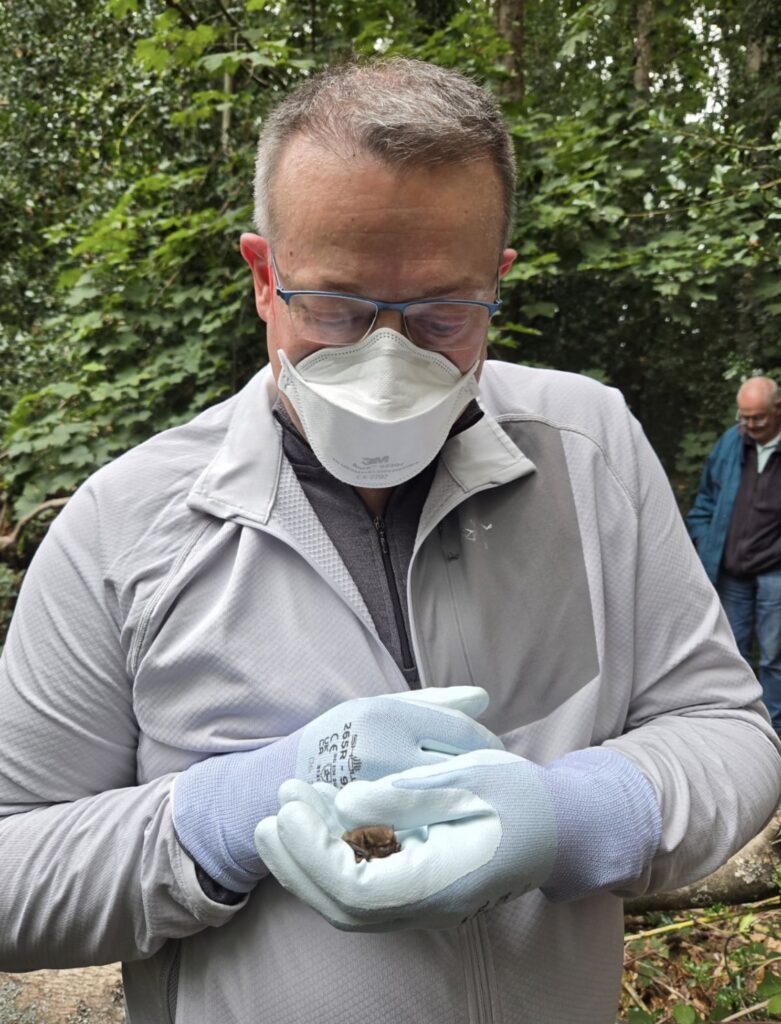
We trundled along checking numerous boxes exhibiting evidence of roosting bats, namely their poo, as well as what I imagine was the entire UK population of blue tits creating nests in the large Schwegler 1FW hibernation boxes. However, another colony of bats still eluded us. That was until we arrived at our fifth-last box of the day, a colony of five soprano pipistrelles and the opportunity for me to handle my first bat. From surveying as part of my work I’m fully aware of how tiny they are, with the size of a thumb being sufficient for them to call a feature their home. However, until having held one it’s difficult to imagine just how fragile they truly are.
Here I am handling my first ever bat, I know there’s a mask in the way but believe me when I say I was ear-to-ear cheesing during this entire encounter.
The day was finished with yet another roosting bat find! This time a lone male soprano pipistrelle (seeing a trend yet?) in a large hibernation box. While supposedly unsuccessful in finding love, he has found himself a ba(t)chelor pad (sorry I couldn’t help myself) even Hugh Hefner would’ve been proud of.
Verdicts
David
The dozen or so bats we did see looked to be in good condition, at least to my untutored eye. Despite the ladders, the handling of heavy bat boxes at height and inevitably some uncertain ground, all the volunteers finished the day in similarly good condition. Smiles all round, and we got what we came for.
Well done Claire, Rose-Ann, Alice, Andy and all the other experienced volunteers for planning and running such an interesting day. Everyone was good company, patient and eager to share their skills – and their flapjacks. I hope to join you for more checks, to gain experience and get a bit more stuck in.
Seb:
As I’m sure you’ve worked out by now, the bat of the day was none other than the soprano pipistrelle. A fairly high-pitched and one-noted, yet nevertheless captivating choir to accompany a lovely Sunday doing what we all love best, protecting our local wildlife.
“I must say that a close second-place high point of the day (it’s hard to beat a first bat handling) was experiencing the wonderfully welcoming nature of the BSBBG community attending the check (can’t forget our canine counterparts Rowan and Holly!). Time was taken to pass on knowledge relating to visual identification of bats, and those who’ve attended many a group check were more than happy to allow us newcomers the opportunity to get stuck in. I’d recommend everyone of any background to look at joining as its truly a rewarding and fun experience.